
Follow your bliss.
The metaphors found in myths (or songs or films) must be kept alive and why not through the vehicle of a magazine because the people that do that are artists. Artists evoke symbols and motifs that point beyond themselves and the world of phenomena into the transcendent and connect us to our deeper selves and help us along the journey of our lives.
Learn More

Issue nº 21 / 1 of 2
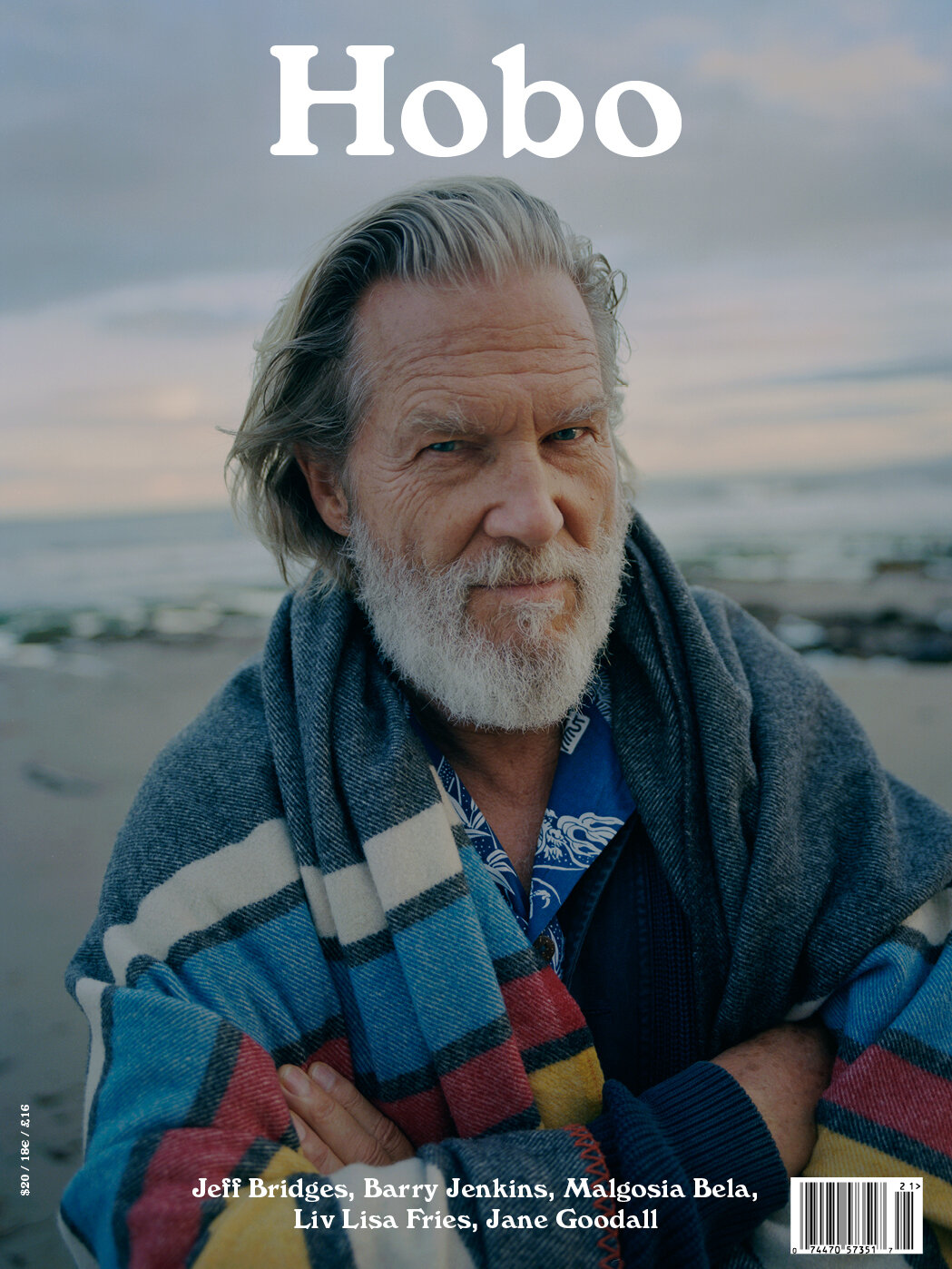
In this issue Jeff Bridges asks what kind of future we would like to see and what we are willing to contribute towards creating it. Barry Jenkins in Brooklyn and Pawel Pawlikowski photographed by Juergen Teller in Warsaw discuss at length their respective new films. Jane Goodall photographed by Bruce Weber, Edward Burtynsky’s altered landscapes, Harley Weir’s rubbish, the paradises gained and lost of Jules de Balincourt’s paintings and eight Golden Retrievers all point towards a new epoch.
Issue nº 21 / 2 of 2
In this issue Jeff Bridges asks what kind of future we would like to see and what we are willing to contribute towards creating it. Barry Jenkins in Brooklyn and Pawel Pawlikowski photographed by Juergen Teller in Warsaw discuss at length their respective new films. Jane Goodall photographed by Bruce Weber, Edward Burtynsky’s altered landscapes, Harley Weir’s rubbish, the paradises gained and lost of Jules de Balincourt’s paintings and eight Golden Retrievers all point towards a new epoch.

Issue nº 20
A vision of the West, both mythic and real, featuring Sam Shepard, the Safdie brothers, photo essays by Bernard Plossu and Cass Bird, travel diaries by Jack Pierson and Quentin de Briey, and reportage fashion stories by Valerio Spada and Emma Tempest.

Issue nº 19 / 1 of 2
“You cursed brat! Look what you’ve done! I’m melting! Melting! Oh what a world, what a world.” – Wicked Witch of the West
An Arctic-themed issue featuring Adam Driver, Isabelle Huppert, Melaw Nakehk’o, Sea Legacy founder Paul Nicklen, stories by Mark Borthwick, Drew Jarrett and Jerry Hsu, trips to Svalbard—terra incognita or the fence furthest north—and to find one of the largest Douglas Firs in the world, Big Lonely Doug.

Issue nº 19 / 2 of 2
An Arctic-themed issue featuring Isabelle Huppert, Adam Driver, Melaw Nakehk’o, Sea Legacy founder Paul Nicklen, stories by Mark Borthwick, Drew Jarrett and Jerry Hsu, trips to Svalbard—terra incognita or the fence furthest north—and to find one of the largest Douglas Firs in the world, Big Lonely Doug.

Issue nº 18
A return to nature populated by interviews with (and a new poem by) Gary Snyder, Doug Seus and Léa Seydoux, a European lynx named Ria, drawings from North Captiva by Jack Pierson, Steffy Argelich in the Italian Alps by Quentin de Briey, the Pacific Northwest by Alana Paterson, Larissa Hofmann in the Costa Brava, Caroline Brasch Nielsen on Bornholm Island, and the summer of 1966 in Northern California by Bernard Plossu.

Issue nº 17
Peruse, “carefully, to catch yourself in your own mondegreen.” Cass Bird by Daria Werbowy, Benjamin Clementine, Patrick deWitt, Father John Misty, Vava Ribeiro and Charlotte Carey in Rockaway, Magnus Unnar and Z Berg in Los Angeles, Dudu Lake and the Blue Lagoon by Martien Mulder, sea wolves and grizzly bears by Ian McAllister, the small islands of Ventotene and Capraia by Bernard Plossu, and the emotional impact of songs by Stephen Scobie.

Issue nº 16 / 1 of 2
It’s almost as much fun reading Tilda Swinton’s reflections on Only Lovers Left Alive (and for that matter Stephen Scobie’s thoughts on Inside Llewyn Davis) than it is to watch the films themselves. Issue nº 16 is more than ever about artists, films, travels and wild nature. It also features Alejandro Jodorowsky, the unique career path of Norman Reedus, Frédéric Beigbeder, Iceland by Magnus Unnar, Tati Cotliar by Drew Jarrett and a firsthand account on the world’s last wild wolves.

Issue nº 16 / 2 of 2
It’s almost as much fun reading Tilda Swinton’s reflections on Only Lovers Left Alive (and for that matter Stephen Scobie’s thoughts on Inside Llewyn Davis) than it is to watch the films themselves. Issue nº 16 is more than ever about artists, films, travels and wild nature. It also features Alejandro Jodorowsky, the unique career path of Norman Reedus, Frédéric Beigbeder, Iceland by Magnus Unnar, Tati Cotliar by Drew Jarrett and a firsthand account on the world’s last wild wolves.

Issue nº 15
An art-themed issue wherein Harmony Korine is interviewed on the back of Spring Breakers, his evocative and Dionysian film on a culture of surfaces, and photographed by Terry Richardson. The issue is a canvas looking for the vocabulary to articulate Stella Tennant photographed by Mark Borthwick, Vava Ribeiro’s visual essay on Hawaii, the recollections of Aaron Rose, the self-reflective self-portraiture of Rodney Graham, works by Elliott Puckette and a portfolio of seven new American artists by Tim Barber.

Issue nº 14
A very New York issue with a free-for-all interview of Willem Dafoe photographed by Terry Richardson, John Giorno in his Bunker on the Bowery, Jade Berreau by Yelena Yemchuk, Tom Waits by Anton Corbijn, wisdom from the consummate Editor-at-Large, Glenn O’Brien, a post-humous interview with Walt Whitman and essays on John Cassavetes’ Opening Night and Don DeLillo’s Cosmopolis. Agnès Varda, Jonathan Anderson, a fashion story by Gia Coppola, Shailene Woodley, Justine Kurland’s photos of America and a poetry folio also bid you to enter.

Issue nº 13
In this issue: Michelle Williams interviewed by Shawn Dogimont and photographed by Mark Segal, the freedom and self-determination of Justine Kurland’s road trips with her son across the American landscape, Mike Mills, Tom Robbins, Araki’s muse, Kaori, by Marlene Marino, Viktoria Winge in Nesodden by Lina Scheynius, Thomas McDonell by Theo Wenner, the unresolved theft of the Musée de l’Art Moderne in Paris and Tom Robbins on Blaise Cendrars.

Issue nº 12 / 1 of 2
Issue nº 12 features Mark Gonzales interviewed by Glenn O’Brien and photographed by Ari Marcopoulos, Big Sur by Todd Cole, Yann Martel, sketches by the Coast Salish painter Lawrence Paul Yuxweluptun, Ken Lum, Rinko Kikuchi photographed in Tokyo by Chikashi Suzuki, Isabel Marant, Inuit performance artist Tanya Tagak and the parc des Buttes Chaumont as seen by Ola Rindal.

Issue nº 12 / 2 of 2
Issue nº 12 features Mark Gonzales interviewed by Glenn O’Brien and photographed by Ari Marcopoulos, Big Sur by Todd Cole, Yann Martel, sketches by the Coast Salish painter Lawrence Paul Yuxweluptun, Ken Lum, Rinko Kikuchi photographed in Tokyo by Chikashi Suzuki, Isabel Marant, Inuit performance artist Tanya Tagak and the parc des Buttes Chaumont as seen by Ola Rindal.

Issue nº 11 / 1 of 2
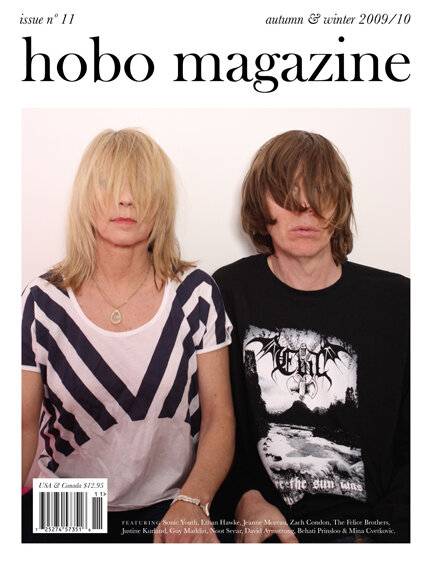
In issue nº 11 we see Ethan Hawke creating a narrative with Brian Hendricks, Sonic Youth (Kim Gordon, Thurston Moore) photographed in upstate NY by Ari Marcopoulos, Jeanne Moreau interviewed at home in Paris, Guy Maddin in Winnipeg, the photographer David Armstrong and portals into the realm of railroad folklore by Justine Kurland.
Issue nº 11 / 2 of 2
In issue nº 11 we see Ethan Hawke creating a narrative with Brian Hendricks, Sonic Youth (Kim Gordon, Thurston Moore) photographed in upstate NY by Ari Marcopoulos, Jeanne Moreau interviewed at home in Paris, Guy Maddin in Winnipeg, the photographer David Armstrong and portals into the realm of railroad folklore by Justine Kurland.
Issue nº 10 / 1 of 2
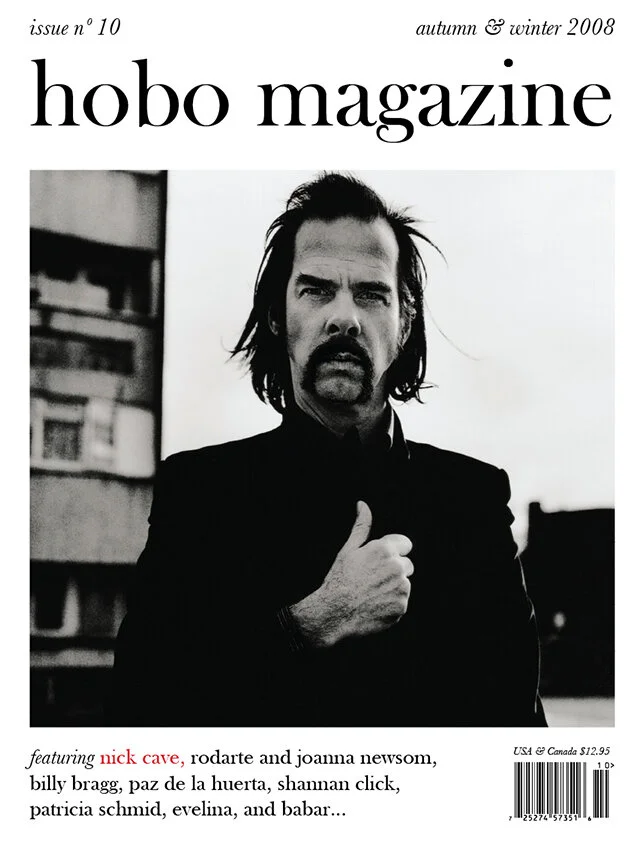
Issue nº 10 argues the importance of print and features Nick Cave by Anton Corbijn, Billy Bragg, Rodarte by Joanna Newsom, Shannan Click in Woodstock by Dan Martensen, Ana Claudia Michels by Marcelo Gomes, Paz de la Huerta, Deanna Templeton, Ibiza, Abel Ferrara, the concerts of Leonard Cohen by Stephen Scobie, Jean and Laurent de Brunhoff’s early drafts and watercolors of Babar and a supplement by Henry Roy.

Issue nº 10 / 2 of 2
Issue nº 10 argues the importance of print and features Nick Cave by Anton Corbijn, Billy Bragg, Rodarte by Joanna Newsom, Shannan Click in Woodstock by Dan Martensen, Ana Claudia Michels by Marcelo Gomes, Paz de la Huerta, Deanna Templeton, Ibiza, Abel Ferrara, the concerts of Leonard Cohen by Stephen Scobie, Jean and Laurent de Brunhoff’s early drafts and watercolors of Babar and a supplement by Henry Roy.
Issue nº 9 / 1 of 3
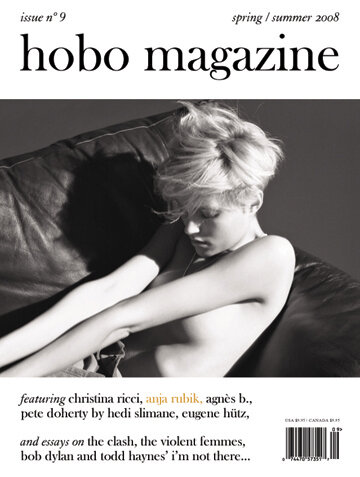
In this issue we see the same boots worn across North American history by pilgrims and settlers, Civil War veterans, railroad workers on the Transcontinental or hanging from boxcars during the Great Depression. A dissertation on Bob Dylan’s lost song and Todd Haynes’ film, I’m Not There, Agnès b., The Clash, Violent Femmes, Eugene Hütz, Christina Ricci, hitch-hikers, Anja Rubik by Lachlan Bailey, Courtney Love, Pete Doherty, Alison Mosshart and Kate Moss by Hedi Slimane, and yes, hobo stories from the road and the rails following the wind and the stars under an open sky.

Issue nº 9 / 2 of 3
In this issue we see the same boots worn across North American history by pilgrims and settlers, Civil War veterans, railroad workers on the Transcontinental or hanging from boxcars during the Great Depression. A dissertation on Bob Dylan’s lost song and Todd Haynes’ film, I’m Not There, Agnès b., The Clash, Violent Femmes, Eugene Hütz, Christina Ricci, hitch-hikers, Anja Rubik by Lachlan Bailey, Courtney Love, Pete Doherty, Alison Mosshart and Kate Moss by Hedi Slimane, and yes, hobo stories from the road and the rails following the wind and the stars under an open sky.

Issue nº 9 / 1 of 3
In this issue we see the same boots worn across North American history by pilgrims and settlers, Civil War veterans, railroad workers on the Transcontinental or hanging from boxcars during the Great Depression. A dissertation on Bob Dylan’s lost song and Todd Haynes’ film, I’m Not There, Agnès b., The Clash, Violent Femmes, Eugene Hütz, Christina Ricci, hitch-hikers, Anja Rubik by Lachlan Bailey, Courtney Love, Pete Doherty, Alison Mosshart and Kate Moss by Hedi Slimane, and yes, hobo stories from the road and the rails following the wind and the stars under an open sky.
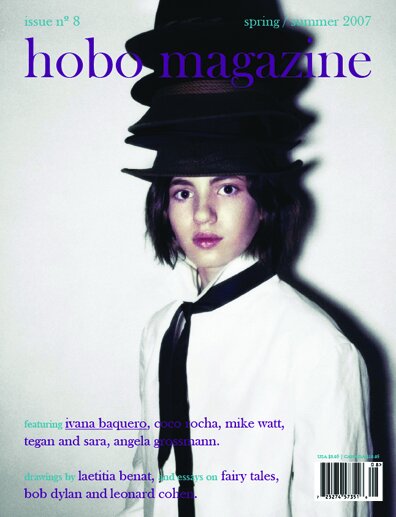
Issue nº 8
Everything is a story. Ivana Baquero is the twelve-year-old star who, as Ofelia, allows herself to believe in the power of the imagination in Guillermo del Toro’s Pan’s Labyrinth. Tegan and Sara, Mike Watt, the great cinematographer Sven Nykvist, the fairy tale illustrated by Laetitia Benat, Angela Grossman, Coco Rocha, Masanobu Ando, Pondichéry by Henry Roy, thoughts on Leonard Cohen and Bob Dylan by the academic (and fan) Stephen Scobie and an essay longing for the return of doubt are just more forms of stories in between “once upon a time” and “happily ever after”.
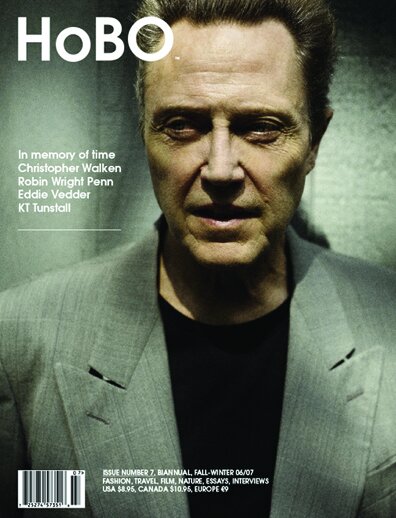
Issue nº 7 / 1 of 2
Photographers Jenny Gage and Tom Betterton crossed time zones to capture the versatile and ageless thespian Christopher Walken in Rhode Island and the talented and beautiful Robin Wright Penn (interviewed by writer/director Erin Dignam) in Venice, California. Eddie Vedder is interviewed by his friend Tim Robbins, Brian Hendricks meets KT Tunstall, a fashion story by Camille Vivier (and styled by her mother Claire Dupont) is inspired by the Wim Wenders classic Alice in the Cities and Henry Roy photographs Hobo’s extended family on the coast of BC and contrastingly, Ludivine Sagnier at the Meurice in Paris.

Issue nº 7 / 2 of 2
Photographers Jenny Gage and Tom Betterton crossed time zones to capture the talented and beautiful Robin Wright Penn (interviewed by writer/director Erin Dignam) in Venice, California and the versatile and ageless thespian Christopher Walken in Rhode Island. Eddie Vedder is interviewed by his friend Tim Robbins, Brian Hendricks meets KT Tunstall, a fashion story by Camille Vivier (and styled by her mother Claire Dupont) is inspired by the Wim Wenders classic Alice in the Cities and Henry Roy photographs Hobo’s extended family on the coast of BC and contrastingly, Ludivine Sagnier at the Meurice in Paris.

Issue nº 6
Philip Seymour Hoffman talks about his craft and the creative life. The sixties are revisited in the nomadic realism of Bernard Plossu’s Mexico, the origins of the nonfiction novel with Capote and the autobiographical film with Fellini’s 8 1/2. Norwegian philosopher and eco guru Arne Naess, Norway by Ola Rindal, Tulum by Mark Borthwick, Canada through the film work of Don McKellar and Mia Kirshner, a post-humous interview with Ralph Waldo Emerson juxtaposed with the micro-mystical nature of Ibiza, Manu Chao, Vanessa Bruno, Irina Lazareanu… all momentary distractions from our own elusive destinations.

Issue nº 5
The chameleon prowess of Naomi Watts, Seu Jorge the City of God actor who growls acoustic renditions of Bowie classics in The Life Aquatic, Leslie Feist, Joana Preiss, John Frusciante, Aaron Huey and his dog Cosmo who, over the course of 154 days, walked across America together recording a world of faces and places that transcend the differences that divide, a guide to personal growth involving grizzly bears by Douglas Chadwick, Ola Rindal’s memories of Japan, Jean-Luc Godard’s Our Music, Charles Bukowsky’s Barfly and a search for the magic settings of Barbet Schroeder’s More in Ibiza.

Issue nº 4
“As a woman I have no country. As a woman my country is the world.” – Virgina Woolf
The sensitive and discreet Charlotte Gainsbourg, snapshots by Ryan McGinley, the blue chadaris of the women of Afghanistan by Titouan Lamazou, confined in luxurious hotels on the fringes of African life in Cameroon and the Congo by Henry Roy, Bernard Plossu’s Nouvelle Vague influenced moments, the spiritual and feminine time sculpting of Russian filmmaker Andrei Tarkovsky, goddesses and gypsies Emmanuelle Béart and Angela Lindvall.

Issue nº 3
Viggo Mortensen’s ephemeral photos taken from his recent travels to Morocco and the Northern Plains and based on lived experiences, interviews with Noam Chomsky and Molly Parker, roads by Bernard Plossu, Tokyo by train, Moscow by Norman Reedus, the lost travelers of Sofia Coppola’s Lost in Translation, Haiti by Titouan Lamazou, the weathered landscapes and people of Cuba, Bolivia and Brazil by Xavier Roy, Breathless, Blow Up and Bertolucci and the short fiction of Buenos Aires affirm that art is not created, it is lived and then reported.

Issue nº 2
After being reincarnated as Anita Berber, Asia Argento steps out of a magic theatre in Los Angeles... Saul Williams, Tommy Chong, poems by Viggo Mortensen, the ideas of love, freedom and power in L’Atalante by Jean Vigo, Easy Rider by Dennis Hopper and Aguirre, The Wrath of God by Werner Herzog, wanderlust, a search for meaning and the quest for self-realization in Herman Hesse’s Steppenwolf, Jack Kerouac’s On the Road and James A. Michener’s The Drifters. All roads lead nowhere so you might as well follow one with wild abandon.
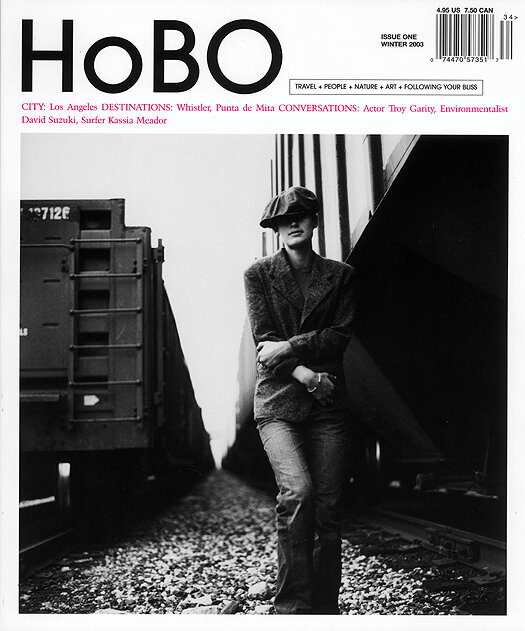
Issue nº 1
Twenty-year-old wandering surfer Kassia Meador photographed by Véronique Vial, Venice by Rick Roberts, David Lynch’s Mulholland Drive, the human psyche and the naïve conception of LA that exists in our imaginations, Troy Garity, photos and sketches from solo navigator Titouan Lamazou, three poems by Canadian novelist (and screenwriter of The Sweet Hereafter) Allen Bell, scientist and environmentalist David Suzuki, the soul of Whistler by Jessica Humphrey and six classic films that explore open roads and open endings.